

Published by Allen Brown
You just opened a restaurant in Montreal. The menu is finalized, the kitchen is stocked, and the first reservations are coming in. But before you serve a single plate, there is a list of digital accounts that need to be set up: WhatsApp so customers can message about reservations, Instagram so you can post photos of the space, Google Business Profile so people can find you on Maps, and Uber Eats and DoorDash merchant accounts so delivery orders come through.
Every single one of these asks for your phone number. Your personal phone number.
By the end of the first week, your personal mobile is attached to five business platforms. Customers can see it. Corporate databases store it. And if you ever want to change it, you risk losing access to verified accounts that took hours to set up. This is the phone verification problem that Canadian small business owners run into constantly, and most do not think about it until they are already locked in.
A temporary phone number canada with a local area code handles all of these verifications without your personal number ever entering the equation. The platforms get a working number. You keep your privacy. And when an employee who set up the accounts leaves, the number stays with the business, not with them.
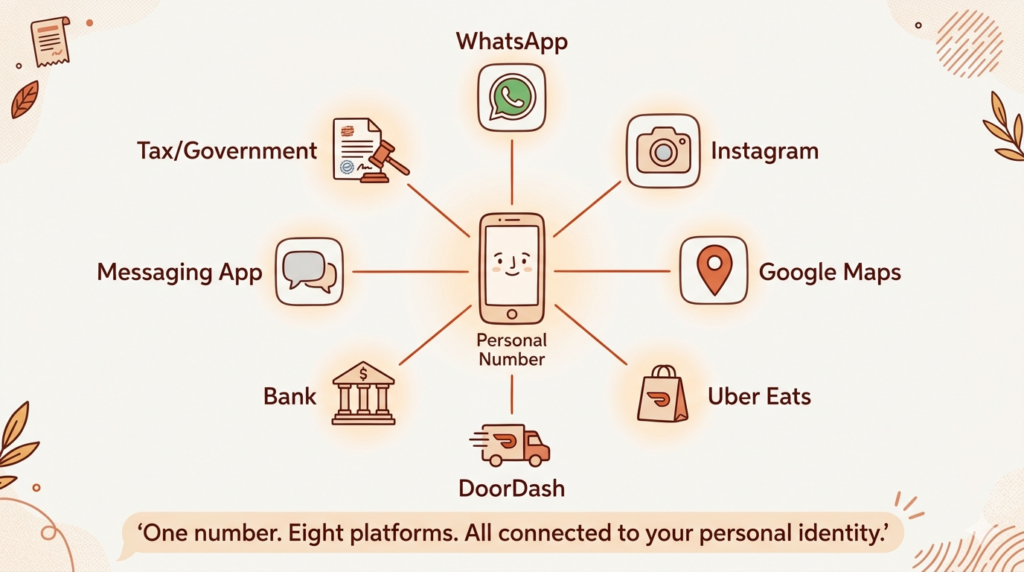
Alt text: “Personal phone number connected to multiple business platforms showing single point of exposure for Canadian business owners”
The Personal Number Trap Nobody Warns You About
Here is how it usually plays out. You set up the business Instagram with your personal number because the account needs to be verified today and you do not have another option. Two months later, a dissatisfied customer finds your personal number through the platform and starts calling at midnight. You cannot remove the number without triggering a re-verification that could lock you out of the account for days.
This is not a hypothetical. It is the standard experience for Canadian entrepreneurs who use personal numbers for business verification.
The problem compounds with scale. A restaurant with a single location might manage with one personal number across a few platforms. A business expanding to a second location, or a brewery opening a taproom alongside its production facility, suddenly needs duplicate accounts for each location. Each account requires a unique temporary phone number canada because platforms enforce strict one-number-per-account policies. You cannot verify two Instagram business accounts with the same phone number.
And then there is the employee problem. When a manager sets up the business WhatsApp using their personal number and later leaves the company, the business loses access to that verified account. Re-verification requires the original number. If that number now belongs to someone who no longer works for you, recovery ranges from difficult to impossible.
The pattern repeats across every platform: WhatsApp, Instagram, Google Business, Uber Eats, DoorDash, Square, and Shopify. Each one captures a phone number during setup, ties the account to it permanently, and makes changing it painful enough that most business owners simply accept the exposure.
Why Canadian Area Codes Matter More Than You Think
Canada shares the +1 country code with the United States. For global platforms like WhatsApp and Instagram, a Canadian 514 number and an American 212 number are treated identically. Both carry +1, both pass verification, and the platform does not care which side of the border the number originates from.
But for Canadian-specific services, the area code tells a different story.
Google Business Profile verification for a restaurant on Saint-Laurent Boulevard expects a 514 or 438 area code. A US area code attached to a Montreal business listing looks suspicious to Google’s local verification system and, just as importantly, to the customers who see it. A brewery in Calgary verified with a 403 number signals local authenticity. A brewery in Calgary verified with a 310 (Los Angeles) number raises questions.
Canadian banking verification is even stricter. Opening a business account, setting up payment processing, or registering for provincial tax services often requires a Canadian mobile number with a recognizable area code. A temp number canada provisioned through a real Canadian carrier agreement with a 416, 604, 514, or 403 area code passes these checks because the number is indistinguishable from a physical SIM.
For entrepreneurs operating in Quebec specifically, the area code also carries cultural weight. A 514 number says Montreal. A 418 says Quebec City. Using a local area code on customer-facing platforms is a small detail that signals belonging to the community you serve.
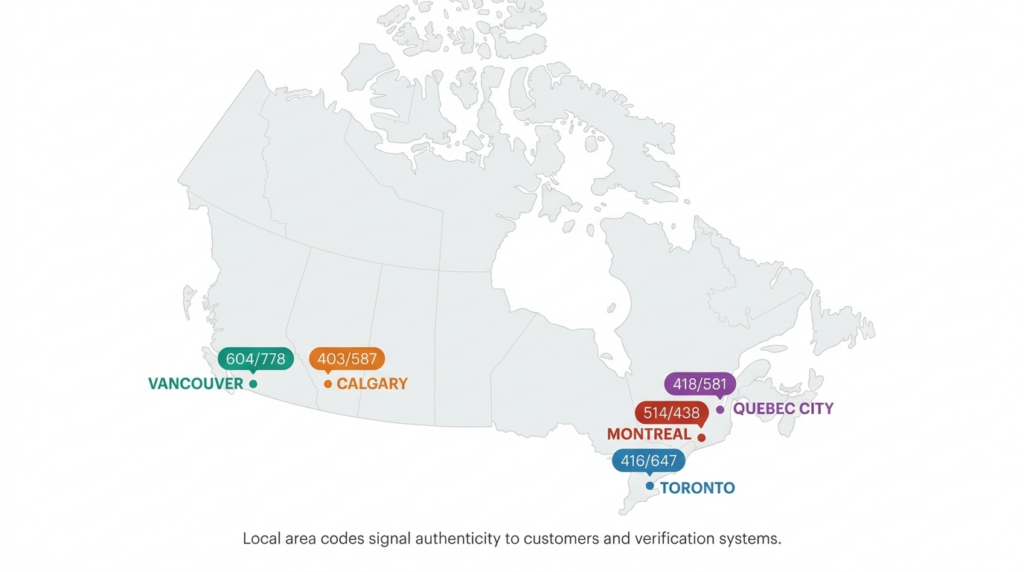
Alt text: “Canadian area codes mapped to major cities showing 514 Montreal, 416 Toronto, 604 Vancouver, 403 Calgary, and 418 Quebec City”
When a US Number Works Just as Well
Not every verification requires a Canadian area code. For platforms that do not screen by regional origin, any +1 number works identically.
WhatsApp, Telegram, Discord, and most social media platforms accept both Canadian and American +1 numbers without distinction. If you are setting up a WhatsApp Business account primarily for international customers rather than local ones, a US virtual phone number performs identically to a Canadian one and sometimes carries a slightly higher acceptance rate because US area codes are the most widely tested in platform verification systems globally.
The decision rule is simple. If the service is local (Google Business, Canadian banking, provincial government portals), match the area code to Canada. If the service is global and your customers do not see the number, either Canadian or US works.
Setting It Up: What Business Owners Actually Need to Know
The operational side is less complicated than it sounds once you understand the two types of numbers available.
Rental numbers stay active for weeks or months. These are what you want for any platform that might re-verify your account later: WhatsApp, Google Business, and any service tied to ongoing business operations. WhatsApp, in particular, triggers periodic re-verification. If the number you used during initial setup has expired, you lose access to the account and all the customer conversations tied to it.
Temporary numbers work for one-off signups where you do not need ongoing access. Testing a new delivery platform, creating an account to evaluate a competitor’s service, or registering for an event management tool you plan to use once.
The setup takes under two minutes. Choose a Canadian area code that matches your province, provide the number through a temporary number for verification platform, enter it during the signup process, receive the verification code on your dashboard, and complete the account setup. The number is dedicated to your account. Nobody else receives your codes.
Quackr provisions numbers through real Canadian carrier agreements with area codes across major provinces. The numbers pass verification on WhatsApp, Instagram, Google Business, and every other platform that Canadian entrepreneurs commonly need because they are real carrier numbers, not internet telephony.
One practical rule worth following: use a separate number for each platform rather than reusing one number across multiple services. If one platform flags a number for any reason, the flag does not cascade to your other business accounts.
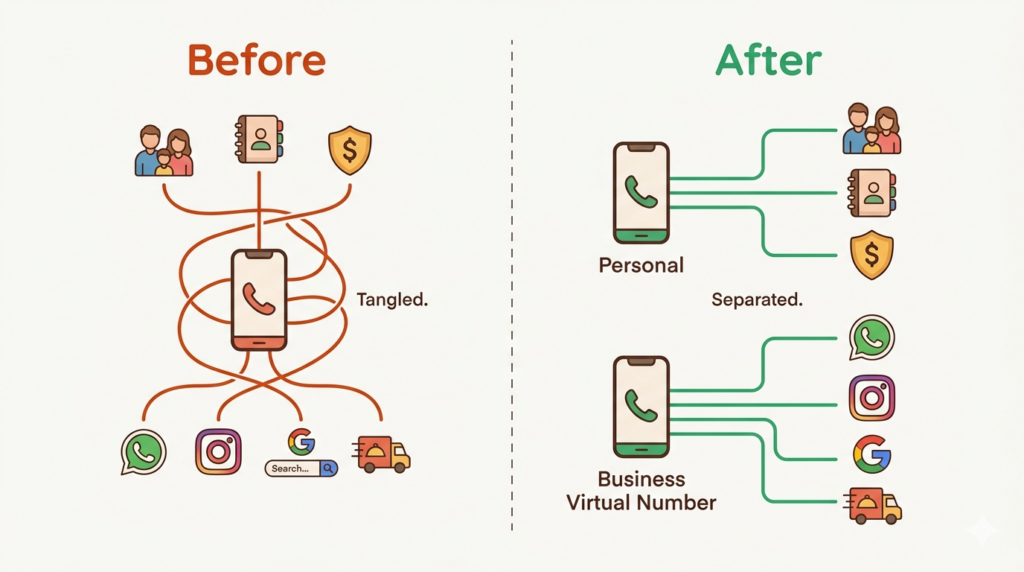
Alt text: “Diagram showing separated personal and business phone numbers for Canadian small business verification.”
What This Means for Privacy and PIPEDA
Canada’s Personal Information Protection and Electronic Documents Act governs how businesses handle personal information, including phone numbers collected during verification. When an employee uses their personal number to verify a business account, that personal number becomes part of the business’s operational infrastructure while remaining the employee’s private information. This creates a data handling ambiguity that PIPEDA was not designed to resolve neatly.
Virtual numbers eliminate the ambiguity entirely. The number used for business verification belongs to the business. It is provisioned, managed, and retired through the business’s own accounts. When an employee leaves, the number stays. When a platform requires re-verification, the business controls the process. No personal data is entangled with business operations.
For businesses that handle customer data through verified platforms (which is nearly every business that uses WhatsApp or Instagram for customer communication), separating personal and business phone numbers is not just a convenience. It is a data governance decision that simplifies PIPEDA compliance.
Before You Set Up Your Next Account
The next time a platform asks for your phone number during business account setup, pause before entering your personal mobile. Consider these five things:
Canadian number for local services. Google Business, banking, and provincial platforms need a recognizable Canadian area code. A 514 for Montreal, a 604 for Vancouver, a 403 for Calgary.
Any +1 number for global platforms. WhatsApp, Instagram, and Telegram do not distinguish between Canadian and US numbers. Use whichever you have available.
Rental number for accounts you keep long-term. WhatsApp and Google re-verify periodically. A number that expires after a week leaves you locked out.
Separate numbers for each platform. Cross-platform number reuse creates cascading risk if one platform flags the number.
Never use your personal mobile for business verification. The convenience feels worth it on day one. It stops feeling worth it the first time a customer calls your personal number at 11 PM to ask if you are still serving.